B2B Sales Coaching Best Practices: How Voice AI Creates Consistency at Scale
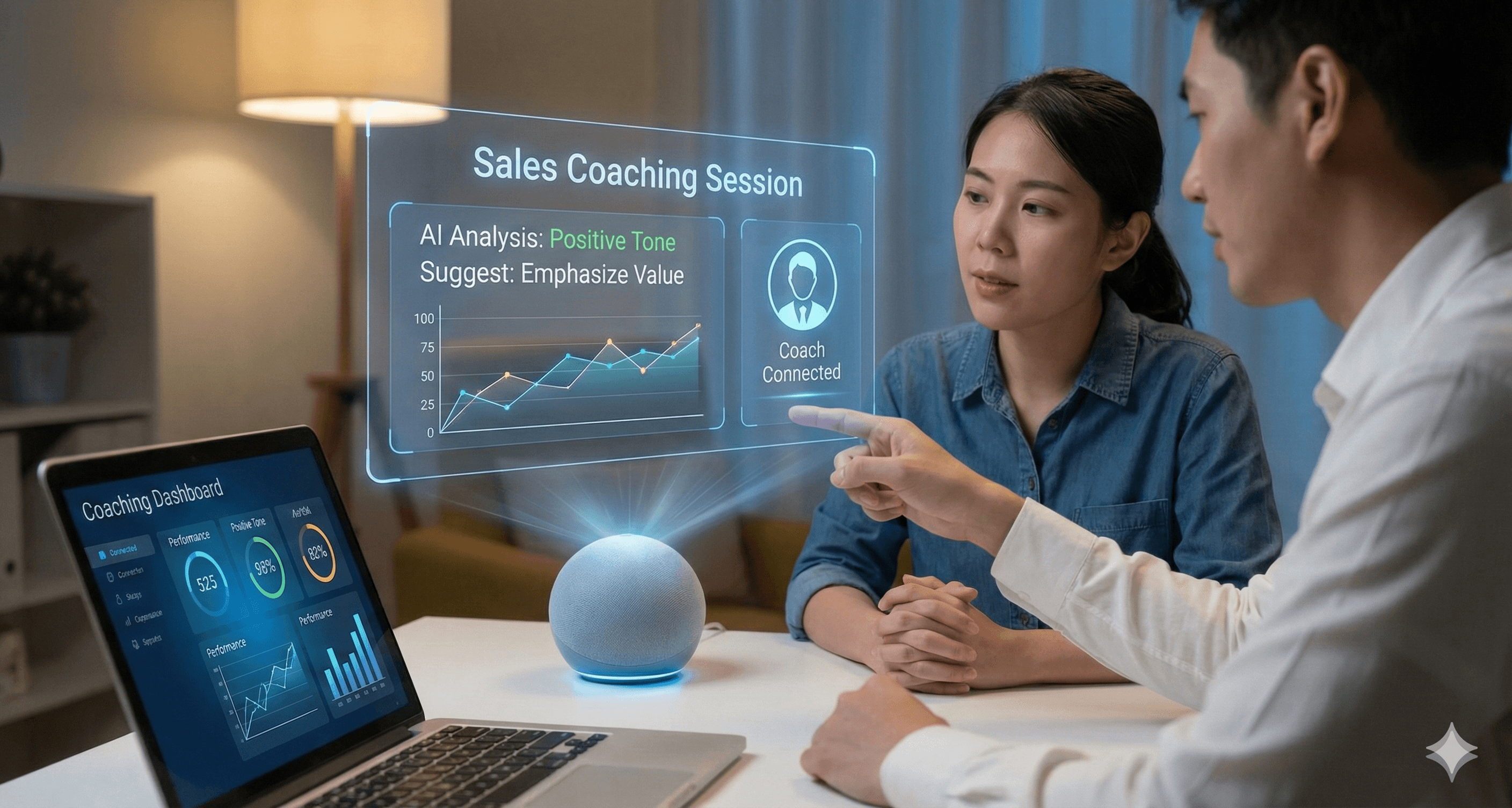
What Is B2B Sales Coaching?
Here's what passes for sales coaching at most companies: A biweekly 30-minute call where your VP of Sales asks reps about their pipeline, scribbles notes about forecast numbers, and maybe—if there's time—asks a few questions about that stuck deal.
That's not coaching. That's a forecast review with a friendlier name.
Real sales coaching is the process of providing ongoing guidance, feedback, and skill development to reps through actual deal inspection, call review, and Socratic questioning. It's continuous, not occasional. And the goal is to help reps think critically about their deals—not just tell them what to do.
Most companies aren't doing this. They think they are, but they're not.
Types of B2B Sales Coaching
Not all sales coaching serves the same purpose. Understanding the different types helps you build a complete coaching program.
Deal Coaching
Focused on specific opportunities in the pipeline. Deal coaching inspects individual deals to identify risks, gaps, and next steps. This is where the Socratic method and thorough deal inspection matter most.
Skill Development
Focused on developing specific sales competencies: discovery, objection handling, negotiation, closing. Skill coaching often involves call review and role-play.
Methodology Reinforcement
Helps reps apply your chosen sales methodology—whether that's MEDDIC, Challenger, Sandler, or something else. Methodology coaching ensures consistent execution of your sales process.
Performance Coaching
Addresses overall rep performance patterns. Why is this rep's win rate declining? Why does that rep struggle with larger deals? Performance coaching looks at trends over time.
Career Developing
Goes beyond quota attainment to help reps develop professionally. Where do they want their career to go? What skills do they need to get there?
Most sales coaching programs over-index on deal coaching (often disguised as forecast reviews) and under-invest in skill and career coaching.
Why Traditional B2B Sales Coaching Falls Short
So why does this happen? The standard sales coaching model makes it almost inevitable. A manager meets with each rep once a week or every other week. They review the pipeline, ask about key deals, and update the forecast. Maybe they discuss a stuck opportunity if there's time.
Traditional sales coaching fails for three reasons:
Coaching Happens Too Late and Too Rarely
By the time your VP of Sales sits down with a rep, the critical moments have passed. The discovery call where they failed to uncover the real decision-maker happened two weeks ago. The demo where they talked 80% of the time? Ancient history.
Managers observe maybe 1-2% of actual sales conversations. You can't coach what you can't see.
Forecast Reviews Replace Deal Inspection
Most sales coaching sessions are actually pipeline interrogations:
"What stage is this deal?"
"When will it close?"
"What's your commit number?"
These are forecast questions. They don't develop skills. They don't help reps think differently about their deals.
Real deal inspection uses the Socratic method—asking questions that force reps to examine their own assumptions:
"What specifically did the economic buyer say about budget timing?"
"Walk me through exactly how you confirmed they have authority to sign."
"What happens to this deal if your champion leaves?"
When you ask these questions, reps discover their own gaps. That's sales coaching. Asking "When will this close?" is not.
The Math Doesn't Work
A Sales Director with 6 reps, each running 15-20 active opportunities, cannot meaningfully coach every deal. So they focus on the biggest ones—the deals that might save or kill the quarter. Everything else gets a glance.
This isn't a manager problem. It's a structural problem with how sales coaching has always worked.
So how do you fix a structural problem? You change the structure.
Sales Coaching Best Practices
Based on what actually works—not what sounds good in theory—here are the sales coaching best practices that separate high-performing teams from everyone else.
1. Use Voice AI to Coach Immediately After Calls
The best sales coaching happens while the conversation is still fresh. Reps forget 87% of call details within a week. Waiting for the weekly 1:1 means coaching based on foggy memories and optimistic interpretations.
Voice AI makes it possible to deliver coaching feedback immediately after every customer conversation—not just the ones the manager joins. The rep talks through what happened with an AI coach that asks questions, uncovers gaps, and helps them reflect while the details are still sharp.
2. Use the Socratic Method for Deal Inspection
Telling reps what they did wrong doesn't create lasting change. Asking questions that help them discover their own gaps does.
Bad coaching: "You should have asked about budget earlier."
Good coaching: "At what point did you feel most confident in that call? What about least confident?"
The Socratic method forces reps to think critically. When they identify their own mistakes, they own the solution.
3. Inspect Deals, Don't Just Review Forecasts
True deal inspection requires going deeper than pipeline stages and close dates. It means using the Socratic method to ask second and third level questions:
"You said they're the decision-maker. How specifically did you confirm that?"
"What happens if your champion leaves before this closes?"
"You mentioned they have budget. Did they tell you that, or are you assuming?"
These aren't gotcha questions. They're the questions that surface risk before it kills the deal. Most managers skip this level of inspection for all but the largest opportunities—which is exactly why so many "committed" deals slip.
4. Create Consistency Across the Team
One of the biggest gaps in sales coaching is inconsistency. Different managers coach differently. Some reps get intensive attention; others get almost none. There's no standard for what good coaching looks like.
The best sales coaching programs establish consistent frameworks:
Standard questions for deal inspection at each stage
Defined coaching cadences that don't get skipped
Clear criteria for what "qualified" actually means
5. Feed Coaching Insights Back to Enablement
Individual coaching conversations reveal patterns. If 60% of your reps struggle with the same objection, that's not a coaching problem—it's a training gap.
Effective sales coaching creates a feedback loop: Identify skill gaps → Enablement addresses them → Confirm it's working.
Most organizations miss this connection entirely.
How Voice AI Changes B2B Sales Coaching
Here's where the sales coaching model is evolving. Voice AI now makes it possible to deliver consistent, Socratic coaching at a scale human managers can't.
Live Coaching After Every Call
Instead of waiting for the weekly 1:1, reps can get coaching feedback immediately after every customer conversation. A voice AI acts as a virtual VP of Sales, asking questions about specific moments in the call:
"You mentioned Sarah is your champion. What's her personal win if this deal closes?"
"Who's the economic buyer and have you engaged them directly yet? What's your plan to get access?"
"Walk me through the decision process they described. Who else needs to sign off before this moves forward?"
The rep has to articulate their thinking out loud—not type it into a CRM field. This is the Socratic method at scale.
Voice AI Creates a Methodology Mindset
Here's something that surprised us: When reps get voice coaching immediately before and after calls, they start thinking in MEDDIC all the time—not just when they're filling out Salesforce fields or prepping for their weekly 1:1.
Right now, most reps only think about their sales methodology when someone's asking them about it. They reverse-engineer their MEDDIC answers after the fact to make their deals look qualified. The methodology becomes a reporting exercise, not a selling tool.
But when a voice AI asks "Who's the economic buyer?" immediately after every call, reps start asking that question during the call. They know it's coming. They start guiding their own discovery because they want better answers for the coaching conversation.
This is the shift: Reps stop thinking about MEDDIC as something they report on and start using it as the framework for how they actually sell.
Why Voice Surfaces More Truth
There's a reason this works better as a voice conversation than a written summary or chat interface.
When reps fill out CRM notes, they write what they want to remember. When they answer written coaching questions, they craft their responses. But when someone asks a question out loud and they have to respond verbally, in real-time, they can't polish it.
Hesitations show. Uncertainty is audible. Reps will admit things verbally that they'd never type into a system their manager sees.
Voice AI creates psychological safety while still surfacing the truth about what's really happening in deals.
Pattern Recognition for Sales Enablement
Every AI coaching conversation generates data. Not just call recordings—actual coaching interactions where reps explain their thinking, identify their gaps, and say what they'll do differently.
Sales enablement can now see patterns across the entire team:
"67% of reps are failing to confirm economic buyer authority before the demo stage."
"New reps spend 3x longer on feature explanations than top performers."
"Objection handling around implementation timeline is a team-wide gap."
This is the feedback loop that traditional sales coaching can't create. One-on-one manager sessions are anecdotal. AI-powered coaching at scale gives you statistical proof of where to focus enablement resources.
The Role of Sales Managers in AI-Assisted Coaching
A fair question: If AI handles coaching, what do sales managers do?
The answer is they go deeper.
Voice AI handles the high-frequency, consistency-dependent work—making sure every call gets reviewed, every rep gets questions, every deal gets basic inspection. The basics get hammered in daily, not discussed once a week.
This frees managers to focus on what actually matters:
Analyze coaching trends. Managers can review patterns across all the voice coaching conversations their reps are having. Where are the consistent gaps? Which reps are struggling with the same things over and over? This turns managers into diagnosticians, not just coaches.
Focus weekly calls on strategy, not basics. When voice AI is reinforcing MEDDIC and deal inspection daily, the weekly 1:1 doesn't need to cover fundamentals. Managers can spend that time on deep deal strategy—the political dynamics, the multi-threading approach, the executive engagement plan.
Shift toward enablement. With visibility into team-wide coaching data, managers can identify skill gaps and work with enablement to address them. They're not just coaching individuals—they're improving the whole team.
AI doesn't replace human sales coaching. It changes what managers spend their time on.
Building a B2B Sales Coaching Program
If you're building or rebuilding your sales coaching program, here's a practical framework.
Step 1: Define Your Framework
Before you coach, define what you're coaching for:
What questions should managers ask at each deal stage?
What does "qualified" actually mean at your company?
What skills matter most for your sales motion?
Document this. Make it consistent across all managers.
Step 2: Establish Your Cadence
Decide how often coaching happens and stick to it:
Weekly 1:1s for deal and performance coaching
Immediate post-call feedback (via AI or manager ride-alongs)
Monthly skill development sessions
Quarterly career conversations
The cadence matters less than the consistency. Coaching that happens sporadically doesn't build skills.
Step 3: Implement Voice AI
Technology should support your coaching program, not replace it:
Call recording and intelligence platforms capture what actually happens
Voice AI can deliver immediate post-call coaching at scale
CRM integration ensures coaching insights connect to deal data
Analytics dashboards surface patterns for enablement
Step 4: Train Your Managers
Most sales managers were never taught how to coach. They were promoted because they were good at selling, not developing others.
Invest in coaching the coaches:
How to ask Socratic questions instead of giving answers
How to conduct effective deal inspection
How to balance coaching with forecast management
How to use AI coaching data effectively
Step 5: Close the Loop with Enablement
Connect coaching insights to your sales enablement program:
What gaps are showing up repeatedly in coaching conversations?
Which skills need more training investment?
Where is the current training failing to change behavior?
Without this feedback loop, coaching and enablement operate as separate silos.
Measuring Coaching Effectiveness
How do you know if your sales coaching program is working? Track these metrics:
Leading Indicators
Coaching session completion rate (are sessions actually happening?)
Rep engagement in coaching conversations
Deal inspection coverage (what percentage of deals get properly inspected?)
Time to first coaching interaction after calls
Lagging Indicators
Win rate changes over time
Sales cycle length
Average deal size
Quota attainment
Rep ramp time for new hires
Behavioral Indicators
Adoption of sales methodology
Quality of CRM data and deal notes
Rep self-identification of deal risks
Implementation of coaching recommendations
The best programs track all three—not just quota attainment.
Common Sales Coaching Mistakes
Even well-intentioned sales coaching programs fail. Here are the most common mistakes:
Confusing Forecast Reviews with Coaching
If your 1:1s are dominated by pipeline updates and commit numbers, you're doing forecast management, not coaching. The tell: You leave the meeting knowing more about the deals but the rep hasn't learned anything new.
Inconsistent Execution
Coaching that happens sporadically or varies wildly between managers doesn't build lasting capability. Consistency matters more than perfection.
Telling Instead of Asking
Managers who give answers instead of asking questions create dependent reps. The Socratic method takes longer in the moment but builds self-sufficient sellers.
Ignoring the Enablement Connection
Coaching without a feedback loop to enablement means you're solving the same problems over and over. Individual fixes don't address systemic gaps.
Over-Relying on Technology
AI and call recording are tools, not solutions. Technology supports good coaching but doesn't replace the need for thoughtful frameworks and skilled managers.
The Future of B2B Sales Coaching
Sales coaching is evolving rapidly. The companies getting ahead are:
Implementing voice AI to reinforce sales methodologies before and after every call—getting reps to think in MEDDIC constantly, not just when they're updating Salesforce
Connecting coaching data to enablement to fix patterns, not just individual deals
Shifting manager time from high-frequency basics to high-value strategic coaching
The technology exists. The question is whether you're willing to move beyond the weekly 1:1 model that hasn't fundamentally changed in decades.
Your competitors are figuring this out. The B2B sales coaching best practices that worked five years ago won't be enough for the next five.